Your How do solar sails work images are ready. How do solar sails work are a topic that is being searched for and liked by netizens now. You can Download the How do solar sails work files here. Get all free vectors.
If you’re looking for how do solar sails work pictures information related to the how do solar sails work keyword, you have pay a visit to the right site. Our website frequently gives you suggestions for seeking the maximum quality video and image content, please kindly search and locate more enlightening video content and graphics that fit your interests.
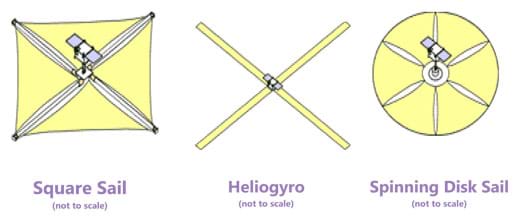
How Do Solar Sails Work. Photons transfer some of their momentum to the sail thereby propelling it along very much like a sailboat in the ocean. Solar sails are giant flat sheets of very thin reflective material – 40-to-100 times thinner than a piece of writing paper – supported by an arrangement of lightweight booms or masts. Solar sails utilise radiation pressure by combining the imparted pressure over a very large surface area. Since speed isnt exactly one of solar sails strong.
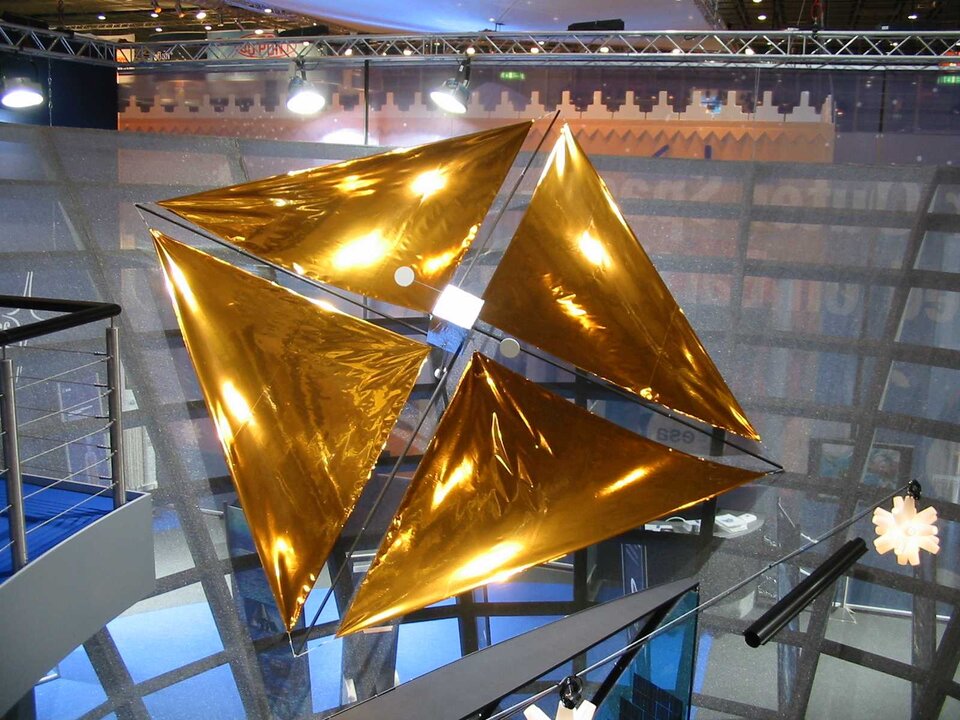 Esa Solar Sails From esa.int
Solar sails utilise radiation pressure by combining the imparted pressure over a very large surface area. This is how a solar sail works. In other words they possess kinetic energy by virtue of their motion. A solar sail spacecraft has large reflective sails that capture the momentum of light from the Sun and use that momentum to push the spacecraft forward. Solar sails are large ultra-thin mirrors that are pushed by the pressure of light photons on their reflective surface. From KSP we know that applying force prograderetrograde allows us to raiselower our orbits and plan orbital encounters.
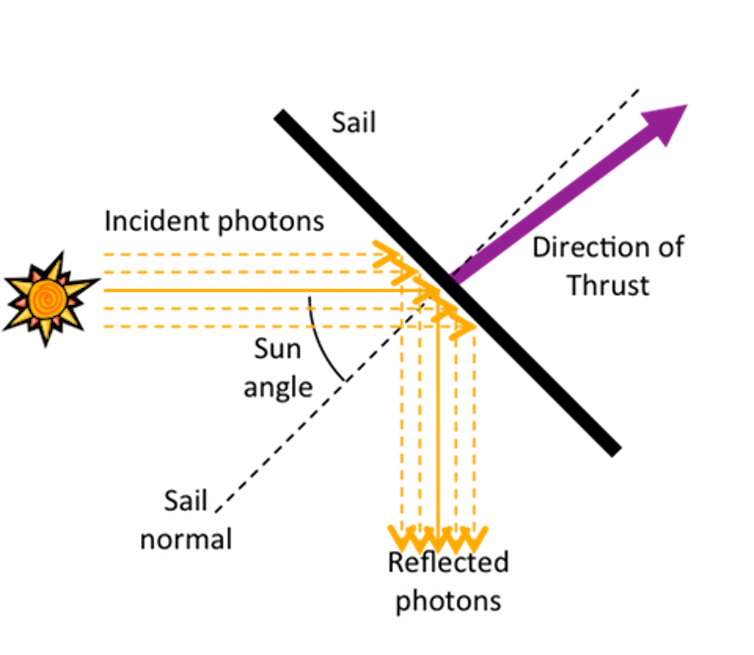
Firstly if you angle the sail does the craft feel a force other than directly radial to the sun.
If a proper shell has not been designed or if the shell has not been fully constructed via the launch of many Small Carrier Rockets a Solar Sail will join the Dyson Swarm instead of a Dyson Sphere Shell. Solar sails work by capturing the energy from light particles as they bounce off a reflective surface according to the Department of Energy. Also if the sail is directly facing the sun is it the light pressure or the solar wind that exerts the most force. Solar sails are steerable by adjusting the reflecting angle. Each light particle has momentum and when it strikes a. These particles of light have no mass and yet when they impinge on something they can.
 Source: youtube.com
As billions of light particles hit the sheet they push the sail strongly enough to move a spacecraft. While this exerts relatively little force upon. Solar sails are a spacecraft propulsion method utilizing a curious quirk of photons. Ie can you adjust the thrust vector. These particles of light have no mass and yet when they impinge on something they can.
 Source: nasa.gov
Solar sails typically have 20 to 30 square meters of collecting area but some proposals have been made for designs with half a square kilometre of collecting area. This is how a solar sail works. Solar sails are large ultra-thin mirrors that are pushed by the pressure of light photons on their reflective surface. The more energetic the wave is the higher its frequency and so dividing by frequency is. The sails reflect sunlight which provide the force needed to push a spacecraft through space without using any fuel.
 Source:
Ie can you adjust the thrust vector. While the photons are themselves conventionally massless they still possess relativistic mass. The more energetic the wave is the higher its frequency and so dividing by frequency is. Solar sails use the suns energy to propel spacecraft across the cosmos. A Solar Sail launched into orbit by the EM-Rail Ejectors will have one of two fates it can either be part of the Dyson Swarm or become part of the Dyson sphere proper.
Source: esa.int
How Do Solar Sails Work. Photo courtesy NASA Hundreds of space missions have been launched since the last lunar mission including several deep space probes that have been sent to the edges of our solar system. Did you know theres a way for spacecraft to travel farther faster and maybe one day reach other stars. Photons transfer some of their momentum to the sail thereby propelling it along very much like a sailboat in the ocean. Solar sails are steerable by adjusting the reflecting angle.
 Source: youtube.com
If the sail is being used to accelerate away from the light source the photons will be redshifted with the energy that the photon loses being added to the velocity of the sail and if the sail is being used to decelerate the approach towards the light source the photons will be blueshifted with the energy the photon gains being subtracted from the momentum of the sail. Note that this is different than solar wind which provides a slightly smaller force. Solar sails are giant flat sheets of very thin reflective material – 40-to-100 times thinner than a piece of writing paper – supported by an arrangement of lightweight booms or masts. Magnetic sails are steerable by adjusting the direction of its magnetic field this changes the direction that the charged particles are deflected in. Ie can you adjust the thrust vector.
 Source: reddit.com
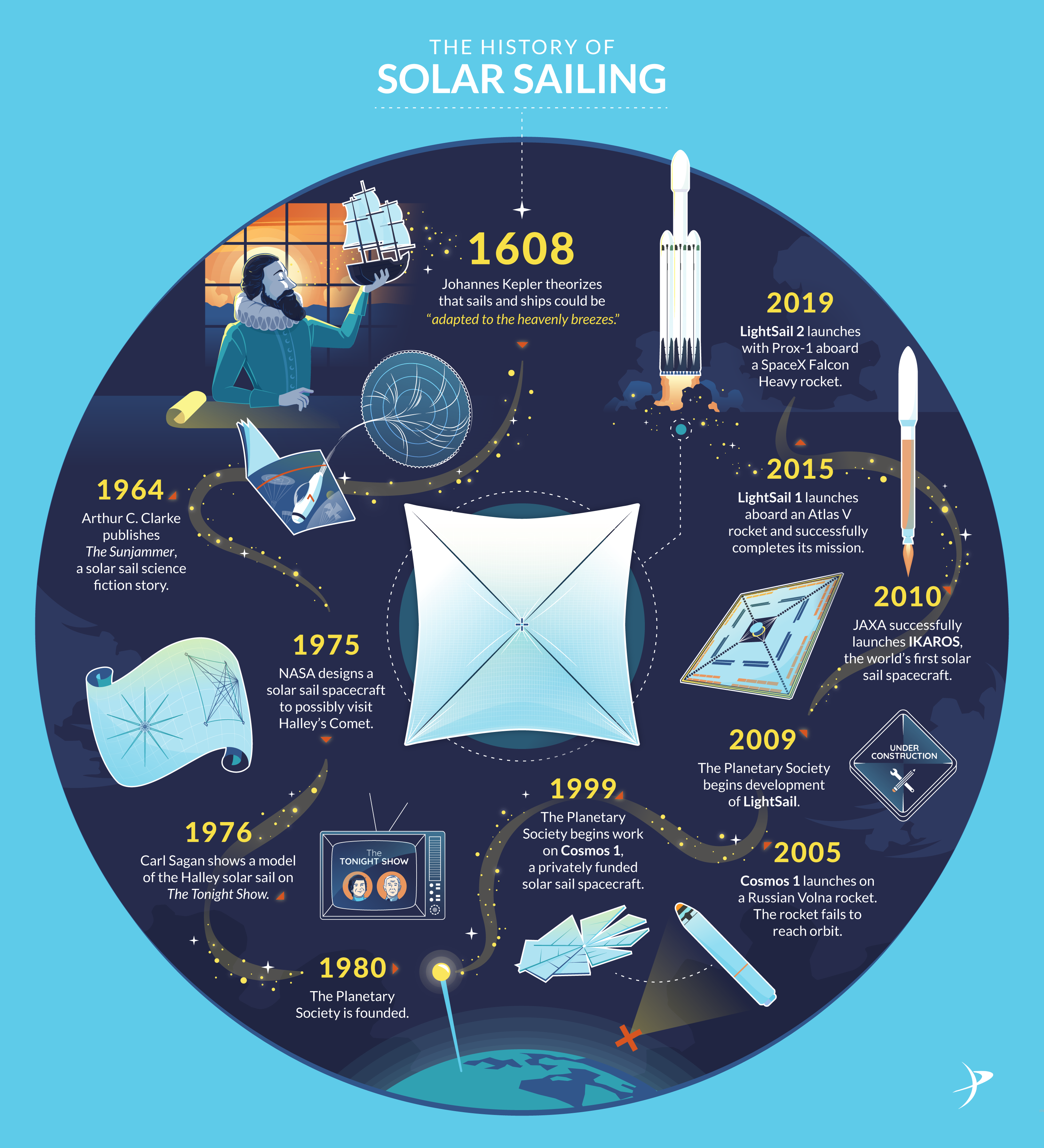
Solar sailing is a revolutionary way of propelling a spacecraft through space. The Planetary Societys LightSail 2 mission is one example of this technology in action. Ie can you adjust the thrust vector. Bill Nye is here to teach you about the game-changi. How Do Solar Sails Work.
 Source: theconversation.com
How do Solar Sails work. Solar sails work by capturing the energy from light particles as they bounce off a reflective surface according to the Department of Energy. From KSP we know that applying force prograderetrograde allows us to raiselower our orbits and plan orbital encounters. Solar Sails first capture the energy from the suns light particles that bounce off a reflective surface. Did you know theres a way for spacecraft to travel farther faster and maybe one day reach other stars.
 Source: teachengineering.org
These particles of light have no mass and yet when they impinge on something they can. Solar sails are large ultra-thin mirrors that are pushed by the pressure of light photons on their reflective surface. Solar sails would theoretically ride the radiation pressure of light that are being emitted by the Sun the sails being large ultra-thin mirrors that will efficiently reflect the photons to provide the push. Solar sails are giant flat sheets of very thin reflective material – 40-to-100 times thinner than a piece of writing paper – supported by an arrangement of lightweight booms or masts. You can tack solar sails to gain non-radial thrust.
 Source: reddit.com
From KSP we know that applying force prograderetrograde allows us to raiselower our orbits and plan orbital encounters. A Solar Sail launched into orbit by the EM-Rail Ejectors will have one of two fates it can either be part of the Dyson Swarm or become part of the Dyson sphere proper. Since speed isnt exactly one of solar sails strong. At Earths distance from the Sun this adds up to about 1 micro-Pascal of pressure. Answer 1 of 2.
 Source: treehugger.com
Solar sails utilise radiation pressure by combining the imparted pressure over a very large surface area. If a proper shell has not been designed or if the shell has not been fully constructed via the launch of many Small Carrier Rockets a Solar Sail will join the Dyson Swarm instead of a Dyson Sphere Shell. Solar sails are large ultra-thin mirrors that are pushed by the pressure of light photons on their reflective surface. Did you know theres a way for spacecraft to travel farther faster and maybe one day reach other stars. As billions of light particles hit the sheet they push the sail strongly enough to move a spacecraft.
 Source: researchgate.net
Note that this is different than solar wind which provides a slightly smaller force. These types of sails can harness energy from solar winds to move through space using only sunlight. As billions of light particles hit the sheet they push the sail strongly enough to move a spacecraft. While rocket fuel has provided the energy for most space travel so far solar energy may provide the boost for spaceships in the future. Just like cloth sails harness the wind giant reflective sheets called solar sails can harness the suns energy.
 Source: nextbigfuture.com
Did you know theres a way for spacecraft to travel farther faster and maybe one day reach other stars. The way we break up the whole electromagnetic spectrum is by the amount of energy carried by that wave. The sails reflect sunlight which provide the force needed to push a spacecraft through space without using any fuel. Magnetic sails are steerable by adjusting the direction of its magnetic field this changes the direction that the charged particles are deflected in. From KSP we know that applying force prograderetrograde allows us to raiselower our orbits and plan orbital encounters.
 Source: researchgate.net
Solar sails use the suns energy to propel spacecraft across the cosmos. If the sail is being used to accelerate away from the light source the photons will be redshifted with the energy that the photon loses being added to the velocity of the sail and if the sail is being used to decelerate the approach towards the light source the photons will be blueshifted with the energy the photon gains being subtracted from the momentum of the sail. Photons transfer some of their momentum to the sail thereby propelling it along very much like a sailboat in the ocean. At Earths distance from the Sun this adds up to about 1 micro-Pascal of pressure. Solar sails are a spacecraft propulsion method utilizing a curious quirk of photons.
 Source: sciencedirect.com
In other words they possess kinetic energy by virtue of their motion. Solar sails typically have 20 to 30 square meters of collecting area but some proposals have been made for designs with half a square kilometre of collecting area. Magnetic sails are steerable by adjusting the direction of its magnetic field this changes the direction that the charged particles are deflected in. How do Solar Sails work. If the sail is being used to accelerate away from the light source the photons will be redshifted with the energy that the photon loses being added to the velocity of the sail and if the sail is being used to decelerate the approach towards the light source the photons will be blueshifted with the energy the photon gains being subtracted from the momentum of the sail.
 Source: newscientist.com
Just like cloth sails harness the wind giant reflective sheets called solar sails can harness the suns energy. Solar sails are large ultra-thin mirrors that are pushed by the pressure of light photons on their reflective surface. If the sail is being used to accelerate away from the light source the photons will be redshifted with the energy that the photon loses being added to the velocity of the sail and if the sail is being used to decelerate the approach towards the light source the photons will be blueshifted with the energy the photon gains being subtracted from the momentum of the sail. Solar sails use the suns energy to propel spacecraft across the cosmos. Solar sails are giant flat sheets of very thin reflective material – 40-to-100 times thinner than a piece of writing paper – supported by an arrangement of lightweight booms or masts.
 Source: ffden-2.phys.uaf.edu
The more energetic the wave is the higher its frequency and so dividing by frequency is. Magnetic sails are steerable by adjusting the direction of its magnetic field this changes the direction that the charged particles are deflected in. Solar sails are a spacecraft propulsion method utilizing a curious quirk of photons. Also if the sail is directly facing the sun is it the light pressure or the solar wind that exerts the most force. Buy College Essays Online How Do Solar Sails Work.
 Source: planetary.org
A solar sail spacecraft has large reflective sails that capture the momentum of light from the Sun and use that momentum to push the spacecraft forward. Solar sails utilise radiation pressure by combining the imparted pressure over a very large surface area. How do Solar Sails work. Since speed isnt exactly one of solar sails strong. Solar Sails first capture the energy from the suns light particles that bounce off a reflective surface.
 Source: vox.com
Just like cloth sails harness the wind giant reflective sheets called solar sails can harness the suns energy. Solar sails utilise radiation pressure by combining the imparted pressure over a very large surface area. From KSP we know that applying force prograderetrograde allows us to raiselower our orbits and plan orbital encounters. The more energetic the wave is the higher its frequency and so dividing by frequency is. Solar sails are pushed by the pressure caused by photons striking them from all directions at once.
This site is an open community for users to do sharing their favorite wallpapers on the internet, all images or pictures in this website are for personal wallpaper use only, it is stricly prohibited to use this wallpaper for commercial purposes, if you are the author and find this image is shared without your permission, please kindly raise a DMCA report to Us.
If you find this site good, please support us by sharing this posts to your preference social media accounts like Facebook, Instagram and so on or you can also save this blog page with the title how do solar sails work by using Ctrl + D for devices a laptop with a Windows operating system or Command + D for laptops with an Apple operating system. If you use a smartphone, you can also use the drawer menu of the browser you are using. Whether it’s a Windows, Mac, iOS or Android operating system, you will still be able to bookmark this website.


